Showing posts with label journalists. Show all posts

Saturday, May 05, 2007

Alan Johnston and the Durmush clan

(Arik Weiss, Ma'ariv April 18, 2007)

The prime suspect in Alan Johnston's abduction is naturally the Durmush clan (and here and actually all over the net) of Gaza – an organized crime family with many ramifications operating a private militia of several hundred armed terrorists, whose infamous record boasts several similar cases, such as the abduction of two Fox News journalists in August 2006. Rumor has it that USD 2 million bought the release of Steve Centanni and Olaf Wiig.
Up until a few months ago, the relationships between Hamas and the Durmush clan were fruitful and idyllic. Hamas often employed the services of the clan for contracted jobs (assassinations and other dirty work) in exchange for hefty sums of money and constant supply of weapons. The clan's name seems to be connected with the abduction of Israeli soldier Gilad Shalit. The "romance" ended a few months ago when two Durmushes were killed by Hamas gunmen. It appears that Alan Johnston was abducted in order to renew the income lost in the wake of the Hamas-Durmush feud.
An unknown terrorist group in Gaza claimed recently to have executed the BBC correspondent and even promised to release the videotape of the "event", but the footage was never produced. It appears however that the journalist was killed in the abduction and the fake promise was meant only to clear the Durmush clan of the suspicion of abduction and possibly murder. The BBC has been silent all along, probably reluctant to offend the kidnappers by some inappropriate comment. After all, one never knows, the group holding Johnston might be ideology-driven, and that would complicate the situation greatly (I don't get it, most British journalists are such suckers for Palestinian lies and propaganda, that someone like Chas Newkey Burden is frowned upon when visiting Israel for a travel piece; the Palestinians should be licking the asses of British journalists instead of kidnapping and maltreating them – who knows, perhaps even killing them. Sorry, British journalists, I thought you were smarter than that!!! On the other hand, it's not that, it's your irrational anti-Semitism that turns you into such obsequious lackeys ).
Some 20 journalists have been abducted in Gaza in the past few years, and behind inflammatory declarations there were hierarchy skirmishes or cash shortages involved in all instances. Johnston's abduction seemed just another one of those, except one can never be certain that things wouldn't take a turn for the worst (after all, contrary to general belief, Gaza IS a terrorist haven, I might quote Dante's Inferno – Relinquish all hope, ye who enter here. Gaza is Inferno made in the Palestinian Authority with the assistance of Hamas).
Last year, Amit Cohen of Ma'ariv wrote that the American Intelligence Services warned the PA of contacts between an Al-Qaeda operative and a Gaza resident, and that the Gaza resident received USD 5,000 from Al-Qaeda in order to purchase weapons and attack Westerners, mostly US nationals. Luckily, the Gazan resident was apprehended before doing any harm. British officials fear that Johnston's kidnappers may have been acting on behalf of Al-Qaeda (after all it is no secret that Al-Qaeda has been operating in Gaza for some time now).
A close friend of Alan's, Stephen Farrell of the Sunday Times, says the Gaza is so complex and stratified, that it is premature to conclude that Alan is being held by a certain family. As it is practically impossible to distinguish in Gaza between ideology, money and business, one can never be sure of the real cause behind Alan's abduction was, or who it was that kidnapped him. "But this is our line of work," Farrell says, "and this is what we have to cope with, always fearing a missile launched from an IAF helicopter (you just couldn't help releasing that stinking fart via you buccal orifice, now could you, how many journalists were killed by attack helicopters? And while you are at it, don't you know IAF pilots never release a single missile, it's always a double strike, Mr. Farrell, objective journalist!!!), being shot by a Palestinian sniper (that's more like it) or getting caught in the crossfire of two rival gangs shooting it out in the streets of Gaza (now you're talking!).
Farrell himself had a similar experience while being held for ten hours by Sunnis in Iraq: "I know that the real reasons behind Alan's abduction are far more complex than money or faction rivalry, because nobody really knows what's going on in Gaza." (What are you doing over there then, how can you do any honest reporting? Oh, I forget, you are a British journalist, i.e. you can get away with pointing an accusing finger at Israel.)

Prior to Alan Johnston, no-one had been held in Gaza for more than two weeks:
September 27, 2004: Riad Ali, a producer for CNN, was seized at gunpoint from a car in Gaza City. He was freed the following day. CNN said a tape surfaced shortly before Ali’s release in which the producer said he was being held by the Al-Aqsa Martyrs Brigade, a militant Palestinian group with ties to Fatah. The brigade had earlier denied involvement in the kidnapping and had joined other groups in condemning it. Ali said on the tape that he is a Druze, a minority Arab population in Israel whose members often serve in the Israeli army. He called for the Druze not to serve in the Israeli army. No demands were made.
January 8, 2005: Ramon Lobo and Carmen Secanella, El Pais. Reporter Lobo and photographer Secanella of the Spanish daily El Pais were briefly abducted by masked gunmen in Gaza’s Khan Younes refugee camp. They were released unharmed 90 minutes later.
August 15, 2005: Mohammed Ouathi, France 3. Ouathi, a soundman for French television channel France 3, was forced into a car on August 15 by three men with rifles as he walked to his hotel in Gaza City with France 3 colleagues. He was released on August 22. No group claimed responsibility for Ouathi’s abduction. Reuters reported that a Palestinian militant umbrella group called the Popular Resistance Committees said it had helped mediate Ouathi’s release, but it did not identify the kidnappers.
September 10, 2005: Lorenzo Cremonesi, Corriere della Serra. Masked gunmen abducted Italian journalist Cremonesi, of the newspaper Corriere della Serra, in the town of Deir el-Balah in the central Gaza Strip. He was released later that day unharmed. He claimed that all his abductors wanted "was to see their faces on Al-Jazeera."
October 12, 2005: Dion Nissenbaum, Adam Pletts, Knight Ridder. Nissenbaum, a U.S. reporter for the Knight Ridder newspaper chain, and British photographer Pletts, a freelancer working for the news organization, were abducted by armed gunmen in the southern Gaza Strip. “A car followed our vehicle for three or four minutes and then stopped us. Six gunmen pointed their weapons and said ’We want the foreigners,’” Ziad Abu Mustafa, a Palestinian interpreter who was with the journalists, told Reuters. He said the captors ordered him to stay behind as they drove off with the two journalists, heading toward the southern Gaza town of Rafah. The journalists were freed later that day after several hours in captivity. Palestinian security officials said the men were kidnapped by renegade members of the ruling Fatah party, CPJ sources said. They said Fatah officials and Palestinian security officers negotiated their release.
March 14, 2006: Caroline Laurent, Elle, Alfred Yaghobzadeh, SIPA, Yong Tae-young, KBS. Gunmen seized Laurent, a reporter for the French women’s weekly Elle, Yaghobzadeh, a photographer from the photo agency SIPA, and Tae-young, a correspondent for South Korea’s public broadcaster KBS, at the Al-Dira Hotel in Gaza. All three were released unharmed 22 hours later. Palestinian security services said the kidnappers were members of the Popular Front for the Liberation of Palestine, Reuters reported at the time. The abductions came after Israeli forces stormed a prison in the West Bank town of Jericho and seized a PFLP leader, Ahmad Saadat, and five other group members held in connection with the assassination of an Israeli minister.
August 14, 2006: Steve Centanni and Olaf Wiig, Fox News Channel. Centanni and Wiig, a correspondent and freelance cameraman respectively for Fox News Channel, were ambushed by gunmen on Omar al-Mukhtar Street in the center of Gaza City. Two vehicles trapped the journalists’ satellite uplink truck marked “TV.” Gunmen forced the driver to the ground, and abducted the two journalists. A previously unknown group called the Holy Jihad Brigades later claimed responsibility. The group demanded the release of Muslim prisoners held by the United States. The journalists were released unharmed on August 27. They were videotaped converting to Islam and reciting suras. They were also forced to praise their captors in a press conference.
October 24, 2006: Emilio Morenatti, Associated Press photographer, was abducted by unidentified Palestinian gunmen as he walked out of his Gaza City apartment toward his driver and interpreter Majed Hamdan, the AP reported. Hamdan said four gunmen grabbed his keys and phone and told him to turn away, pressing a gun to his head, and threatening to harm him. The gunmen shoved Morenatti into a white Volkswagen and sped off. He was released later that day. The AP said no group claimed responsibility for the kidnapping. (However, Morenatti seems to be quite close to the terrorists, perhaps rivals of the faction that kidnapped him? We'll never know, Stephen Farrell himself cannot make his mind up. However, Morenatti appears to be a very good friend of Kevin Frayer, who eagerly promotes anti-Israeli propaganda, as seen in his contributions from Gaza/West Bank (on an almost daily basis) and Lebanon (during the second Lebanon war).
January 1, 2007: Jaime Razuri, Agence France-Presse, a veteran staff photographer for AFP, was seized by a group of unmasked, armed men as he was entering the news agency’s bureau in Gaza City, AFP reported. He had been returning from an assignment with his interpreter and driver. Razuri was released on January 7. It is unclear who abducted him. Palestinian security officials suspected that the Dughmush family, a large armed clan in Gaza City, was behind the abduction. The Dughmush clan had been pressuring the ruling Islamic Resistance Movement to turn over 18 people suspected of killing two of its members, according to reports and CPJ sources. But an aide to President Mahmoud Abbas said the family helped in releasing the journalist and was not directly linked to the abduction. (Dughmush is an alternate spelling of Durmush.)

Tuesday, April 24, 2007

I love you, Chas Newkey Burden, simply love you!

Not in my name
British journalists' union boycott motion reflects deep animosity towards Israel
Chas Newkey Burden
Published: 04.19.07, 09:41 / Israel Opinion

The British public’s perception of journalists has sunk so low that when I am asked in social situations what my job is, I am sometimes tempted to pretend I am part of a more respected profession – like drug trafficking. I exaggerate, of course, but only a little. Most people view journalists as immoral liars who would sell our own grandmothers for a front-page scoop. I am an altogether softer writer, so when members of my profession publish sensationalist or intrusive stories, I don’t sit and flog myself on their behalf.
However, when the National Union of Journalists (NUJ) passed a motion at its annual meeting to boycott Israel, I hung my head in utter shame and despair - despite the fact that I am no longer an NUJ member. Those emotions of shame and despair were not joined by shock, though, because the British media has long been absorbed by a blind hatred of Israel. Newspapers like The Independent and The Guardian print editorials that are so biased and distorted that Osama Bin Laden would probably blush at them. The BBC refuses to describe suicide bombers who blow up buses full of schoolchildren as "terrorists" and one of its correspondents told a Hamas rally that he and his colleagues were “waging the campaign shoulder-to-shoulder with the Palestinian people”.
I visited Israel for the first time last year to research some articles about tourism there. Within hours of my return I received a call from a journalist acquaintance who asked me with genuine shock: “What’s all this about you going to Israel?” He said that a mutual journalist acquaintance of ours was “absolutely disgusted” with me for going there and that he hoped I was “going to put the boot in” when I wrote my articles.
These were not close acquaintances, I hadn’t even spoken to one of them for nearly nine years and it must have taken them some digging around to find my telephone number. They obviously thought it was worth the trouble to have a dig at a writer who was friendly to Israel. Apparently the “absolutely disgusted” man – a weekly columnist on a high-profile magazine - has since tried to get an article published that claims that Tony Blair murdered Yasser Arafat.

'Those suicide bombers have got guts'
The evening after my return from Israel, I met up with some journalists for some drinks in the West End of London. I was again abused for my trip. Their hatred of Israel was matched only by their adoration of the Palestinians. One of them gushed: “Boy, those suicide bombers have got guts. I wish more people in the world had their courage.” Another of them erupted when I told him that most people in Israel wanted a peaceful settlement to the conflict. “So why,” he asked, “did they murder their most peaceful Prime Minister Benjamin Netanyahu?”
Well, I guess if you’re going to get your facts wrong you might as well get them spectacularly wrong – I wonder if anyone else has ever got Netanyahu confused with Yitzhak Rabin?
I was also warned not to get any ideas about trying to get a positive account of my trip published. In the end I did manage just that but only after an unprecedented, almost sentence-by-sentence dissection of my article by the commissioning editor during the course of which I had to repeatedly remind him that there is such a thing as an Israeli Arab and that not everyone in Israel is an Orthodox Jew. Both facts seemed to come as huge shocks to him. I’ve no doubt that if I had written on "The Hidden Wonders of Tehran" or "The Joy Of Jeddah," I’d have had a much easier ride.
The editor of another magazine once told me I was not allowed to write that Yasser Arafat turned down Ehud Barak’s offer at Camp David in 2000. I asked why and he replied “because of a need for balance.” I pointed out that nobody, including Arafat, has ever disputed that he rejected Barak’s offer and the editor replied: “Well, I don’t know about that but you still can’t write it.” The article in question was an "opinion" piece, so taking sides was exactly the brief – as long as it was not Israel’s side, apparently.
The same magazine had happily published articles accusing Israel of “war crimes” and carried advertising accusing Israel of apartheid policies. The need for balance is relative, it seems.
There was certainly nothing balanced about the NUJ boycott motion. The factual errors in the motion’s wording are clear: For instance they seem not to have noticed that Israel withdrew from Gaza in 2005. It’s a contemptible motion. There’s a phrase that became popular in Britain before the run-up to the war in Iraq. I’ve never liked this phrase because to me it reflects the selfishness of the anti-war lobby. However, in the aftermath of the NUJ motion it sums up perfectly how I feel about the boycott: Not in my name.

And this is not the only article signed by Mr. Burden (sweet Burden, light Burden). He has a very poignant piece about British intellectuals, that I found a bit unsettling, I must confess. I was not surprised, just unsettled by the sheer scale of the phenomenon, which I would not call stupidity or blindness, but rather antisemitism in disguise - the cause of the Palestinians is a worthy cause because Israel can be blamed in the process.


'My Name is Rachel Corrie'
Last uploaded : Friday 5th May 2006 at 19:52
Contributed by : Chas Newkey-Burden
They say a picture is worth a thousand words but sometimes a picture can be worth far more than that. There are more than a thousand words in the play My Name Is Rachel Corrie, about the US activist who accidentally died during an anti-Israel protest in Gaza in 2003. But none of them shed light on the now canonised Corrie as much as a photograph taken of her by the Associated Press a month before her death.
Corrie was snapped burning an American flag and whipping up the crowd at a pro-Hamas rally. This photograph – of which there is no mention in the play – doesn’t just contradict the image of Corrie being saintly and peace-loving, it also raises the question of why an educated, western girl would want to fall in line with an organisation that opposes every core value – freedom, fairness, women’s rights - she claims to hold dear?
Corrie is far from alone. The audience at a recent performance of the play in London’s West End was littered with white, English men and women wearing keffiyeh scarves. Moving and working as I do in liberal, literary circles, I know all about these keffiyeh-wearing types. They consider themselves left-wing or liberal minded. They hold impeccable views on social fairness, the environment and women’s rights. They believe in democracy. They wear Make Poverty History wristbands. They nod sagely at Guardian editorials about poverty in Africa while sipping fair trade lattes.
But raise, if you dare, the Middle East question in front of them and stand back in shock as their spiteful, hateful side comes rushing to the surface. These people who say they back the underdog, believe in democracy, multiculturalism and fairness will spit blood against Israel – the only country in the region that represents those values. They are what I call Palestinian groupies.
I believe these groupies, like the little boys who play army in playgrounds across England, don’t look the other way on the topic of Palestinian terrorism, they seem – sorry to say – almost turned on by it. You surely can’t, after all, overlook something as big as the blowing up of buses or pizza parlours. There is no ‘bigger picture’ regarding people who do that. And why would you appropriate the uniform of the man who backed all that terrorism unless you actively had a thing for him?
Even when the bloodshed is on their doorstep, they remain as blindly loyal as a battered wife who won’t give up on the man who hurts her. These groupies were the ones who on the day London’s transport system was bombed by Islamic terrorists stomped around shouting “I hate Tony Blair” and insisting “We brought it on ourselves”. They also believe, as they sit in their comfortable Western homes, that the whole conflict is about them. My name is Rachel Corrie. Not in my name. Thousands of people are dying but it’s all about me.
Of course, the love is unrequited. When Corrie died, Hamas openly welcomed her death. These poisonous people opposed every core value she held dear in life, then danced on her grave when she died. It is too late for Corrie to see the light, but we would do well to stop idolising her. And all the other Palestinian groupies really should stop lining up to get into bed with these men that hate them.
Chas Newkey-Burden writes for a range of magazines and newspapers including The Big Issue, Attitude and The Mail On Sunday. His book, 'The Reduced History Of Britain,' was published in September 2006.

Now take a look at these figures and tell me that there is something else behind the support for the Palestinian cause, not just hypocrisy hiding behind hatred against the Jews and the Jewish state:

Ranking of 68 Most Lethal Conflicts (10.000 victims or more) after 1950
(and by the way, on the eve of our 59th Independence Day we mourned the 22,305 soldiers dead since 1860).

1 - 40.000.000 Red China 1949-1976 (outright killing, man made famine, Gulag)
2 - 10.000.000 - Late Stalinism 1950-1953; Post-Stalinism 1953-1987 (mostly Gulag)
3 - 4.000.000 - Ethiopia 1962-1992: Communists, artificial hunger, genocides
4 - 3.800.000 - Zaire (Congo-Kinshasa): 1967/68; 1977/78; 1992-1995; 1998-to date
5 - 2.800.000 - Korean war 1950-153
6 - 1.900.000 - Sudan 1955-1972; 1983-2006 (civil wars, genocides)
7 - 1.870.000 - Cambodia: Khmer Rouge 1975-1979; civil war 1978-1991
8 - 1.800.000 - Vietnam War 1954-1975 (more than 90% Vietnamese, Allies)
9 - 1.800.000 - Afghanistan, Soviet and internecine killings, Taliban 1980-2001
10 - 1.250.000 - West-Pakistan massacres in East Pakistan (Bangla Desh 1971)
11 - 1.100.000 - Nigeria 1966-1979 (Biafra); 1993 – to date
12 - 1.100.000 - Mozambique 1964-70 (30.000) and after retreat of Portugal 1976-1992
13 - 1.000.000 - Iran-Iraq-War 1980-1988
14 - 900.000 - Rwanda genocide 1994
15 - 875.000 - Algeria/France 1954-62 (675.000); Islamists/Government 1991-2006
16 - 850.000 - Uganda 1971-1979; 1981-1985; 1994 - to date
17 - 650.000 - Indonesia/Marxists 1965-1966 (450.000); East Timor, Papua, Aceh etc. 1969 -
to date.
18 - 580.000 - Angola 1961-1972 (80.000); after Portugal’s retreat (1972-2002)
19 - 500.000 - Brazil against its native Indians up to 1999
20 - 430.000 - Vietnam after war end in 1975 (own people; boat refugees)
21 - 400.000 - France/Indochina 1945-1954
22 - 400.000 - Burundi 1959-today (Tutsi/Hutu)
23 - 400.000 - Somalia 1991-2007
24 - 400.000 - North Korea up to 2006 (own people)
25 - 300.000 - Kurds in Iraq, Iran, Turkey 1980s and 1990s
26 - 300.000 - Iraq (Saddam against minorities)
27 - 240.000 - Columbia 1946-1958; 1964-to date
28 - 200.000 - Tito Regime Yugoslavia (1944-1980)
29 - 200.000 - Guatemala 1960-1996
30 - 190.000 - Laos 1975-1990
31 - 175.000 - Serbia-Bosnia-Herzegovina
32 - 150.000 - Communist Romania 1949-1989 (Marxists against own people)
33 - 150.000 - Liberia 1989-1997
34 - 140.000 - Russia against Chechnya 1994 to to date
35 - 150.000 - Lebanon (1975-1990)
36 - 140.000 - Gulf War 1990-1991 (Arabs from Iraq and Kuwait, Allies)
37 - 130.000 - Philippines 1946-1954 (10.000); 1972-today (Islamo-Marxists)
38 - 130.000 - Burma/Myanmar 1948-2006
39 - 100.000 - North Yemen 1962-1970
40 - 100.000 - Sierra Leone 1991-to date
41 - 100.000 - Albania 1945-1991
42 - 80.000 - Iran 1978-1979
43 - 75.000 - 2nd Iraq War 2003-2007 (body count)
44 - 75.000 - El Salvador 1975-1992
45 - 70.000 - Eritrea/Ethiopia 1998-2000
46 - 68.000 - Sri Lanka 1997-to date
47 - 60.000 - Zimbabwe 1966-1979; 1980-to date
48 - 60.000 - Nicaragua 1972-1991 (Marxists/natives etc.)
49 - 53.000 - Arab wars against Israel 1948-2006 without Israel-Palestine-Conflict
50 - 50.000 - Communist North Vietnam against own people 1954-1975
51 - 50.000 - Tajikistan 1992-1996 (secularists against Islamists)
52 - 50.000 - Equatorial Guinea (1969-1979)
53 - 50.000 - Peru (1980-2000)
54 - 50.000 - Guinea 1958-1984
55 - 40.000 - Chad 1982-1990
56 - 30.000 - Bulgaria 1948-1989 (Marxists against own people)
57 - 30.000 - Rhodesia (1972-1979)
58 - 30.000 - Argentina Military Junta 1976-1983
59 - 27.000 - Hungary 1948-1989 (Marxists against own people)
60 - 26.000 - Kashmir 1989-to date (Islamists)
61 - 25.000 - Jordan Arabs against Palestinian Arabs (Black September 1970-1971)
62 - 22.000 - Poland 1948-1989 (Marxists against own people)
63 - 20.000 - Syria 1982 against Islamists in Hama
64 - 20.000 - Chinese-Vietnamese war 1979
65 - 18.000 - Congo (Republic) 1997-1999
66 - 19.000 - Morocco/France (3000, 1953-1956) and against Western Sahara Arabs 1975-to date
67 - 12.000 Israel-Palestine - (4.792 from 1947-1987; 1.759 1st Intifada 1987-1991; 5.300 2nd Intifada 2000 - to date, Arabs (ca 80%, some 500 by other Arabs), Jews (ca. 20%). Supposedly mankind’s most dangerous conflict.
68 - 10.000 South Yemen civil war 1986

[All figures rounded; Brzezinski, Z., Out of Control: Global Turmoil on the Eve of the Twenty-first Century, 1993; Courtois, S., Le Livre Noir du Communism, 1997; Heinsohn, G., Lexikon der Völkermorde, 19992; G. Heinsohn, Söhne und Weltmacht, 20068, Rummel. R., Death by Government, 1994; Small, M., Singer, J.D., Resort to Arms : International and Civil Wars 1816-1980, 1982; White, M., “Death Tolls for the Major Wars and Atrocities of the Twentieth Century” (2003), users.erols.com/mwhite28/warstat2.htm] . Heinsohn-May-2007.


Tuesday, October 10, 2006

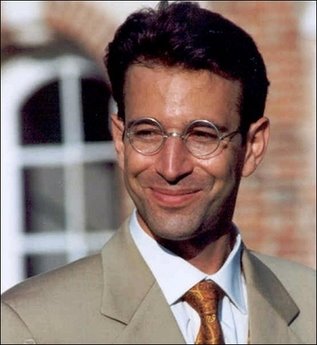
Daniel Pearl

Daniel, you shall not be forgotten!
I would like to take a moment to honour the memory of Daniel Pearl, a brave journalist who would have turned 43 today, had he not been kidnapped and beheaded by islamoterrorists four years ago, for being American, Jewish, and investigating the funding of a terrorist group. The man responsible for his murder is, what a surprise! Omar Sheikh, a London-born student-turned-kidnapper of the London School of Economics.
Daniel was accused of being a Mossad agent, he was forced to speak against Israel and America by his captors who then proceeded to slay him. This is stomach-turning footage. The site still posting Daniel's execution blames Israel as the root of all evil on Earth. That of course entitles brainwashed extremists to take leave of their humanity and act as monsters in order to glorify their evil god, whose name is not worth mentioning.
The Chicago Tribune has the story of the HBO production of Daniel Pearl's life and untimely death at the hands of jihadists.

One wonders, however, why other journalists, who are neither American nor Jewish, are being targetted by the same criminal groups (or their ilk), as EUreferendum so aptly reports.