Ben-Dror Yemini,
Ma'ariv 1 Oct. 2006 (in Hebrew)
This is the second article in a series of investigations of the unique standards applied to the Israeli-Palestinian conflict by the international community and world media. Part I of the series ("And the World is Silent" - 22 Sept. 2006) dealt with the world's silence in response to mass murders by Arabs of their fellow Arabs and Moslems. That silence is of particular significance in light of the constantly reiterated charge that Israel is implementing genocidal policies vis-à-vis the Palestinians - yet this particular genocide is purely fictional. As shown previously, the number of Palestinian casualties inflicted by Israel is trivial compared to the magnitude of casualties inflicted in other ethnic or religious conflicts around the globe. Part II focuses on the unique treatment of Palestinian refugees, by the UN and the international community, compared with the refugees generated by other ethnic and religious conflicts over the course of the last century.
Let us begin with a well-known story. In a country that formerly belonged to the Ottoman Empire, a large Moslem minority continues to reside. There is no love lost between the majority and minority populations, rather a long history of conflict, ripe with mutual hostility . Eventually the majority population forces a large contingent of the minority Moslem population to relocate to a neighboring country with a majority ethnically identical Moslem population.
No, this story is not about Israel and the Palestinians. It is the story of the Moslem Turks in Bulgaria. Nor is it a story from 200 years ago. It took place at the end of the 1980's. Three hundred thousand Moslems were pressured into fleeing Bulgaria. Not forced, just pressured.
If the reader has never heard of the "right of return" of ethnic Turks to Bulgaria, or of any international organizations devoted to their plight, to their suffering in refugee camps, nor read thousands of articles on the subject, the explanation is simple: they are not Palestinians. Nor is the case of ethnic Turks in Bulgaria an isolated one. In the course of the last century, tens of millions of people fled their native lands in the wake of religious or ethnic conflict and redrawal of international borders.
A world full of refugees
Population exchanges have been considered throughout history down to the present as the optimal solution to religious and/or ethnic conflicts. Less than one century ago, Norwegian geographer and statesman Fridtjof Nansen was awarded the 1922 Nobel Peace Prize, in international recognition for designing, initiating and implementing the population transfer between Greece and Turkey.
This does not mean that we are in favor of transfer. Times have changed. Even international moral standards and circumstances have changed. Not every biblical solution is applicable in this day and age. Supporting transfer will no longer win the Nobel Peace Prize.
Entire communities have had no choice but to leave their home country or hometown and relocate. Were the world to impose a "right of return" similar to that advocated for the Palestinians to other instances of population transfer, millions of Moslems would have to move back to India, and millions of Hindus to Pakistan. Entire populations of the Balkan states would have to be reshuffled. Old conflicts that had been laid to rest would be rekindled.That is why no international body advocates the return of Moslems to Greece or Bulgaria, ethnic Greeks to Turkey or Germans to the Sudetenland, etc. And for a very good reason: implementing the right of return to these millions or people would result in the collapse and breaking up of several European states, and the entire continent would be subjected to an endless bloodbath.
The right of return is our winning ticket for the destruction of Israel
Luckily, the world is sane – it does not impose the bloodbath and destruction of Europe and Asia Minor. But there it ends. When it comes to the Palestinians, the world flips. New sets of rules are in order. Whatever holds true for any other conflict in the world cannot apply to God's little acre, which just happens to be the tiny acre of the Jews.
Rules developed for other nations that have been the subject of mass population transfers - India, Pakistan, Turkey, Greece, Czechoslovakia, and dozens of others - suddenly no longer apply when it comes to Israel. Then the world calls for new criteria, which are quite the opposite of what has been accepted thus far. And even then the efforts of entire international organizations focus on one issue alone: the worldwide propaganda campaign devoted not to alleviating the plight of Palestinian refugees but to perpetuating it. Some support the Palestinian "right of return" out of good-hearted naiveté. But many others have a different agenda. Their purpose is not the resolution of the Israeli-Palestinian conflict, but the destruction of Israel. As one of Yasser Arafat's closest advisors, Sahar Habash, once commented, "The right of return is our winning lottery ticket for the destruction of Israel." We shall not dwell on the great migration of peoples recorded by history. Nor are we going to demand that the Arabs who invaded Asia, Africa and Europe return to their homelands. Nor, for that matter, are we going to ask the white conquerors of Africa to move back to Europe and America, in spite of their having raped and plundered those lands foreign to them, not to mention the crimes against humanity committed in so doing.
We are only going to examine some of the population exchanges during the last hundred years, due to their similarity to the vast numbers of displaced people in Israel and the neighboring Arab countries: expulsions, fleeing and willing relocation on both sides.
UNRWA's objective: to perpetuate the Palestinian refugee status
Between 600,000 and 800,000 Arabs left Israel and headed for the neighboring Arab countries, while a similar number of Jews fled their Arab homelands and moved mostly to Israel. This was part of a global population shift not unlike that seen in other parts of the world when new states were created on the basis of ethnicity or religion. Millions of people were sometimes involved in such transfers. Not one person out of these millions is still a refugee. Not even those who made it to Israel. This title is reserved for a single category: the Palestinian refugees.
And this is where the application of the double standard comes into action: the existence of two U.N. bodies for dealing with refugees. The United Nations decreed that the UN Relief and Works Agency (UNRWA) deals exclusively with Palestinians, while the United Nations High Commission for Refugees (UNHCR) is charged with responsibility for all other refugees around the globe. The mission of the UNHCR is to help refugees begin a new life. As a consequence of its activities tens of millions of former refugees do no longer qualify as "refugees" when they gain citizenship in their new host countries. Thanks to UNRWA, the number of Palestinian refugees continues to expand rapidly, as its one and only purpose is to perpetuate the refugee status of the Palestinians.
There are two official definitions for the term refugee. According to UNRWA's definition, any Egyptian, Jordanian, Lebanese, or Syrian citizen whose primary place of residence between June 1946 and May 1948 was within Israel's 1949 armistice lines is classified as a refugee, even if he was only temporarily in the country in search of work. Thus, a mere two-year stay in mandate Palestine ensures anyone an eternal place on UNRWA's refugee list.
An ordinary refugee has to meet a number of criteria in order to qualify for UNCHR assistance. According to the all-encompassing UN definition, those integrated in a new country, where they become active members of society, are no longer refugees. By contrast, not a single Palestinian has ever lost his refugee status. There are hundreds of thousands of Palestinian refugees or their descendants who are citizens of Jordan. Yet as far as UNRWA is concerned they are still refugees. So are several Lebanese government ministers. Why? Because a unique and far more expansive definition of refugee is applied to Palestinians. Palestinian refugees are treated differently than other war refugees.
And there is more. Everywhere else in the world only those who fled their previous place of residence are classified as refugees, but not their descendants or other relatives. With respect to Palestinians, however, refugee status is transmitted from generation to generation - it is hereditary. Indeed. Even if one's children never set foot within Israel's 1949 armistice lines and are as wealthy as Bill Gates, they are still classified as refugees.
The special treatment of Palestinian refugees by the U.N. is not meant to solve the plight of Palestinian refugees but to perpetuate it. As the number of those classified as refugees grows year by year, the only consequence is making any solution of the underlying Palestinian-Israeli conflict practically impossible.
Population Exchanges
The Palestinians were not the only ones to be uprooted by the fighting between Israel and the invading Arab armies in 1948-49. As a result of anti-Jewish rioting in Arab countries in the wake of the war, between 600,000 and 800,000 Jews fled the Arab lands where they had lived for centuries and even millennia. Most of those refugees came to Israel, where they were absorbed without assistance from the international community. Such population exchanges are common following major religious or ethnic strife all around the world. Any place else in the world, the exchange of populations between Arabs fleeing Israel - i.e., the area within the 1949 armistice lines - and Jews fleeing Arab lands would have been the end of story.
Population Shifts in the Balkans
With the exception of the Indian subcontinent, no area of the world has experienced more widespread population shifts over the last century than the Balkan states. From the beginning of the first Balkan War in 1912 to the wars following the dissolution of Yugoslavia, between seven and ten million people were uprooted from their homes on the basis of ethnic identity. It is estimated that in the two Balkan Wars between 1912 and 1915, 250,000 Bulgarians, 150,000 Greeks and 200,000 ethnic Turks were expelled to their ancestral homelands. World War II brought about even more significant population shifts. Three-quarters of a million Serbs fled their homes in the course of the war, and another quarter million were forced into labor brigades in Bulgaria and Hungary. After the conclusion of the war, 300,000 Bulgarian nationals returned to Bulgaria from areas which had been under Bulgarian rule prior to the war. At the same time, 200,000 Hungarians emigrated from Transylvania to Hungary. A similar number of Hungarian nationals were forced to leave their homes in Yugoslavia and Czechoslovakia. The 1920's brought another significant wave of population transfers between Turkey, Greece and Bulgaria, pursuant to the signing of the 1923 Treaty of Lausanne between Turkey and the Entente Powers. The major transfer was that of 1.5 million ethnic Greeks from Turkey to Greece, and 500,000 ethnic Turks from Greece to Turkey. In addition, 80,000 Bulgarians were transferred to Greece. Not all ethnic Greeks (who were Christians) left Turkey for Greece, and not all ethnic Turks (who were Moslems) left Greece for Turkey. But the stated purpose of the population exchange was the creation of religious and ethnic homogeneity. It was Fridtjof Nansen, who won the Nobel Peace Prize, for initiating, planning and implementing the transfer. Events connected to World War II brought further population transfers to the Balkans. After a pro-Nazi government took power in Croatia, thousands of Serbs fled the country. In addition, after Hungary took control of Transylvania, 200,000 Romanians fled Transylvania for Romania.
The world media favored turning Serbs into refugees
The next major wave of population shifts in the Balkans came about as a result of the ten year long warfare that followed the break-up of the former Yugoslavia, after Tito's death in 1991. Following fighting between Croatia and Serbia, 250,000 Serbs were expelled from regions that remained in Croatian hands. According to the peace treaty signed between Croatia and Serbia, a procedure was established for Serbs to reclaim their former homes. In practice, however, few Serbs succeeded in exercising their right to reclaim their former homes. Serbs returning to Croatia encountered job discrimination and various forms of harassment. Most found their homes occupied, and even when they successfully asserted their rights in Croat courts, the courts' orders were rarely executed. In short, whatever sort of "right of return" exists for Serbs, it has proven largely ineffectual. And that is so, even though historic tensions between Serbians and Croats are far lower than those between Palestinians and Israelis. Moreover, 200,000 ethnic Serbs pose no demographic threat to Croatia, with a population of 4.4 million people. Nor have Serbs been subjected to a massive propaganda campaign since 1995 calling for the elimination of Croatia, as Palestinians have been vis-à-vis Israel almost since the outset of the Oslo process.
No right of return in the Balkans
A survey of Western newspapers at the conclusion of the fighting between Serbia and Croatia reveals a general acceptance of the need to create ethnically homogeneous states by means of an exchange of Serbs and Croats. That was more or less the leading position of the New York Times on the issue. In renewed fighting in 1999, 800,000 ethnic Albanians were expelled from the Serbian province of Kosovo. Most of those were subsequently returned to their homes after NATO's military intervention. In the meantime, 150,000 Serbs, fearing Albanian retribution, fled Albania. An equal number of Serbs fled Kosovo, after NATO's intervention, for the same reason. Hundreds of thousands more people became refugees over the course of a decade of fighting in the former Yugoslavia, including an estimated 170,000 Croats who fled Serbia. Some of those refugees fled from one newly created country to another; others fled from one region to another within a single country like Bosnia-Herzegovina. Of the 7-10 million Balkan refugees over the course of less than a century, some became refugees as a result of deliberate efforts at ethnic cleansing, some as a consequence of military action, and others pursuant to treaty. The common denominator of these population shifts, however, is that they all led to increased religious and ethnic homogeneity. And that process was accepted by the international community as necessary in order to prevent far greater bloodshed Only in the case of the Serbs, who were allowed to return to Croatia, was there any recognition of a right of return. And even in that case, that recognition remained almost purely theoretical.
12 million German refugees absorbed in just a few years
Poland - Ukraine
After World War II, Poland's eastern border was set at the so-called Curzon Line, which had first been proposed as the border between Poland and the USSR in 1919 by British Foreign Secretary Lord Curzon. At that time, however, Poland, succeeded in pressing further demands, and under the Treaty of Riga signed in 1921, its eastern border was set on average 200 kilometers to the east of the Curzon Line. The movement of Poland's border westward after World War II led to a total of 1.4 million Poles and Ukrainians crossing the border in opposite directions: ethnic Poles returning westward to Poland and ethnic Ukrainians moving eastward to the Ukraine. Just as in the Balkans, the basis of that transfer was the preservation of ethnic and religious homogeneity.
Germany - Eastern Europe
At the Potsdam Conference after World War II, the Allies met to discuss the post-War administration of Germany, including the fate of ethnic Germans who had settled throughout Eastern Europe and southern Russia over several centuries. The German majority in the Sudetenland had been the pretext for Hitler's demand, at the Munich Conference, for German annexation of the Sudetenland at the expense of Czechoslovakia. After World War II, the Allies were eager to remove any future pretexts for further German expansionism. As a consequence, it was decided that millions of ethnic Germans in the Sudetenland, Romania, Hungary and Poland - many of whom had never been Nazi supporters - be repatriated to Germany "in an orderly fashion." Between 12-16 million ethnic Germans were moved against their will. Some of the ferries carrying the refugees back to Germany were torpedoed. According to some German sources, many Germans were killed in the process of transfer to Germany. Yet just a few years after this mass exodus, there was not one German refugee still in a refugee camp or with refugee status. The fate of those repatriated is nowhere to be found on the public agenda today in Germany, with the exception of one fringe group BdV (Federation of Expellees) that deals with the issue. The consensus in Germany today is that the refugees have no rights - not to restitution and not to return to those areas in which their ancestors lived for centuries.
India-Pakistan
14 million refugees settled successfully
Though Moslems and Hindus joined together to secure India's independence from Great Britain, as independence drew near religious tensions between Moslems and Hindus flared, though religion was only one of the many dividing lines between different sectors of the population. Mahatma Gandhi, the leader of the struggle for Indian independence, envisioned a single state composed of Hindus, Moslems and Sikhs. The British, however, opted for the creation of two states - one majority Hindu and the other overwhelmingly Moslem - to avoid a bloody war between Hindus and Moslems. As a result, British sovereignty over the Indian subcontinent ended in August 1947 with the creation of two states: India and Pakistan. The creation of two states - one overwhelmingly Moslem and the other predominantly Hindu - resulted in a massive population transfer. More than seven million Hindus and Sikhs transferred from Pakistan to India and a similar number of Moslems left India for Pakistan. Many massacres were perpetrated in the process of these population exchanges. Estimates of the number of those killed range from 200,000 to 1,000,000. Today Pakistan is almost entirely Moslem, while India, with almost a billion people, is home to roughly 160,000,000 Moslems. The two countries have lived in a constant state of tension almost since their creation. Much of that tension is focused today on the Kashmir region of India, which abuts Pakistan, and which has a majority Moslem population. Though the creation of India and Pakistan resulted in over 14 million refugees, the absorption of whom placed enormous burdens of the fledgling states that took them in, today not one person still classified as a refugee as a result of that massive population transfer.
Armenia- Azerbaijan
UNHCR helps Armenian refugees, but refuses to touch Palestinians
The break-up of the Soviet Union brought about the formation of new countries and rekindled old ethnic and religious tensions. Chechnya Moslems, who were exiled to other regions of the former Soviet Union during the Stalin era, suddenly returned to Chechnya, and ignited a movement seeking independence from Russia. More closely related to our topic is the Nagorno-Karabakh region of Azerbaijan. The majority of Azerbaijan is Moslem, but within Nagorno-Karabakh, the majority of the people are Armenian Christians. In 1988, this semi-autonomous region sought to be joined to Armenia. That request triggered widespread killings of Moslems in Armenia and Armenians in Azerbaijan. The fighting ended with a ceasefire in 1994, but the conflict gave rise to one million new refugees: 740,000 Moslems fled Armenia for Azerbaijan, and 360,000 Armenian Christians fled Azerbaijan for Armenia. One other interesting detail: Armenia made an effort, in conjunction with UNHCR to absorb its Christian brethren seeking refuge in Armenia. By contrast, the Moslem refugees to Azerbaijan still languish in refugee camps, unabsorbed and unintegrated into Azerbaijan. In that way, the Moslem refugees resemble the Palestinian refugees, many of whom still live in fetid refugee camps nearly sixty years after they became refugees.
The refugee tragedy of Sudan
Sudan has been plagued in recent years by a series of vicious ethnic conflicts: between Moslem Arabs and black animists in the South, and between Moslem Arabs and black Moslems in the Darfur Province, respectively. As a consequence of the warfare between non-Moslem blacks and Arab Moslems, 75,000 blacks were expelled to the neighboring states of Senegal and Mali, and an equal number of Arabs sought refuge in Mauritania in the late '80s and early '90s. Arab militias, known as the Janjaweed are making a concerted effort to rid Darfur of its black population and impose an Arab majority. This is not your run of the mill population exchange. The ethnic and religious cleansing and genocidal policies have resulted in the killing of 200,000 – 400,000 blacks in Darfur. The atrocities committed in the name of the Arab-dominated government in Darfur are creating huge numbers of IDP (internal displaced persons), while three to four more millions have been forced to flee their homes, some into neighboring Chad.
Though both victims and perpetrators in Darfur are Moslems, to date there have been no protests in the Arab world against the ethnic cleansing and genocidal policies being pursued by the Janjaweed against black Darfurians. The Arab-dominated government in Khartoum continues to resist intervention by the U.N. and African peacekeepers, and to do everything possible to prevent them from putting and end to the ongoing atrocities in Darfur. Sudan holds the infamous record of producing the highest numbers of refugees in the world these days.
Cyprus refugees forget about hatred in refugee camps
The population of Cyprus is 80% Greek and 20% Turkish – a remnant of the Ottoman Empire. In response to a threat by the majority Greek population to unite the island with Greece in 1974, Turkish forces invaded the island. As a result of the invasion, Cyprus was divided into two halves: one Greek and the other Turkish. Two hundred thousand ethnic Greeks moved to the Greek-controlled half of the island, and 50,000 Turkish Moslems moved to the Turkish part of the island.
This is not the time and place to draw a comparison between the Cypriot Greeks and the Palestinians: the Greeks did not start the war, did not threaten to drive the Turks into the sea or wipe Turkey off the map. They were victims of the Turkish aggression and violence. Moreover, a Turkish statal entity has been created, unrecognized yet by the world community.
From the time of the partition of the island, the Greek half has flourished - there are no refugee camps, no terror, and no incitement of terror against the Turks, despite the fact that Turkey settled 100,000 more Turks on the Turkish-controlled half of the island (in violation of international law) and brought in tens of thousands of soldiers to maintain its military regime. In contrast to the Greek half of the island, the Turkish half has experienced severe unemployment and a stagnant economy. U.N. Secretary-General Kofi Annan devised a far-reaching proposal to reunite the island in 2004, but in a national referendum, the Greek half of the island rejected the plan. Nevertheless, the U.N. plan does provide an interesting insight into the international community's view of the "right of return" in general. The plan did not hint at a general right of return of those who had fled their homes upon partition of the island. Only Greeks over 65 years old were granted anything like a right of return, and even then, only on condition that they do not exceed 10% of the total Turkish population, and no more than 20% in any particular area. Had Israel accepted such a proposal, it would have had to export Palestinians rather than bring them back for the simple reason that Palestinians already constitute over 10% of Israel's population.
The world turns turns their back on refugees – unless they are Palestinians
The number of refugees (except the Sudanese) during the last century totals approximately 38 million people. International organizations estimate the number of people displaced by the communist regime in the USSR alone to 65 million. The unending civil warfare in Congo and Somalia generate unknown numbers of refugees who remain mostly uncared for. There is no special UN agency to address their needs. They would certainly benefit from the attention the Palestinians garner, but except for a few low-budget relief agencies, the world looks away. They simply fall under different categories and are left to fend for themselves, as the international mass media takes little interest in their suffering. Unlike the Palestinians, they simply do not make the headlines. The Palestinian refugee numbers are growing larger every year thanks to clever manipulation.
Of all the tens of millions of refugees generated by religious and ethnic strife, however, only the 700,000 Palestinians who fled their homes in Israel in 1948 - most of them at the urging of their leaders - remain a "problem" for the UN-led international community nearly sixty years later. All over the world, the same pattern prevails. Those who have been expelled or forced to flee from areas in which they were part of a religious or ethnic minority to areas or countries where
their religious or ethnic group is the majority have been absorbed by their co-religionists or those of the same ethnicity.
That is what happened when Israel absorbed 600,000-800,000 Jews from Arab lands after the creation of the state. And this is what has happened everywhere else in the world. The two Germanys absorbed ethnic Germans after World War II; India took in Hindus fleeing Pakistan, and Pakistan received Moslems fleeing India. That too should be the fate of the Palestinians. They should be absorbed in an independent Arab state of Palestine to be established one day alongside Israel, not instead of Israel. Only the Palestinians (and Moslem refugees to Azerbaijan) depart from the general pattern of absorption by those who share their religion and ethnic identity. The Palestinians were never absorbed by their Arab co-religionists in the countries bordering Israel. They faced both de facto and de jure discrimination in many of those countries. Today hundreds of thousands of those who left Israel in 1948 and their descendants still languish in refugee camps nursing their bitter historical grievances and constituting a permanent attack force to be unleashed against Israel. The Arab states deliberately maintain the Palestinians in their pitiable state. The international community is also complicit in the process. Rather than helping the Palestinians out of their refugee status, UNRWA and international donors have frozen the Palestinians in that status. That holds true not only for those who fled Israel in 1948, but for all their descendants in perpetuity. In lieu of applying medicine, the Palestinians' "benefactors" have only rubbed salt on their wounds - sometimes for their own purposes and sometimes with good intentions. The day that the international community desists from applying a double standard to the Palestinians will be a day of rejoicing for them. On that day, they will stop being political pawns and be on the way to gaining their independence. Of the tens of millions of refugees created by World War II and the grant of independence to India and Pakistan in 1947, all lost their refugee status, as far as the international community is concerned, decades ago. And the possibility of those former refugees returning to the lands of their birth would strike the international community with horror, for an attempt to do so would only unleash old ethnic and religious conflicts. We might as well discuss the return of North America to its original native inhabitants. Only with respect to the Palestinians does the "right of return" continue to be discussed. Not just discussed, but to be the subject of thousands of books, articles, and documentaries. That "right" is never placed in the context of comparable cases of other refugees around the world. Sympathy for the plight of the Palestinians dwarfs that for other peoples who have suffered far worse fates, and who are far less complicit in their fate. The exodus of Palestinians from what is today Israel took place only because five Arab armies invaded Israel immediately after its declaration of independence. And the Palestinians could have had their own independent state a long time ago. Instead, they have chosen to focus their energies on the destruction of Israel. The black farmers of the Darfur province of Sudan constitute just the most blatant current example of the disproportionate sympathy for the Palestinians. The U.N. estimates the number of those killed by Arab Moslem militias at 400,000, while another two to three million people have fled their homes, as a consequence of a concerted effort at ethnic cleansing. And yet it is the plight of the Palestinians that continues to be portrayed as the greatest injustice perpetrated by man against his fellow man in the world today. International humanitarian aid to the Palestinians is by far of the greatest magnitude than that directed towards any other people. (That will be the subject of our third investigation.) Meanwhile the black farmers of Darfur are left to cope as best they can.
The international community has long acknowledged the rule that religious and ethnic homogeneity serves as a deterrent to the most vicious of conflicts. For that reason, Turkish Moslems will not return to Greece nor Greeks to their former homes in Turkey. Sometimes history must be forgotten if peace is to be maintained. Judea and Samaria is the historical homeland of the Jewish people. Yet we do not advocate Jewish rule of that area today, for it is home to another people. But just as Arabs dwelling today in Judea and Samaria have a right to national self-determination, so do Jews. And Israel is the only place in the world where Jews can exercise that right today. Those who call for the "right of return" for Palestinians would deny Jews their right to self-determination. Let us be clear. When we argue that Cyprus is the model for the solution of religious and ethnic conflicts, we do not mean that ethnic and religious homogeneity need not be absolute. There is room for an Arab minority in Israel, just as there is a Jewish minority in Morocco. We oppose with every fiber of our being the idea of transfer - either of Arabs from what is today Israel proper or from Judea and Samaria. Though ethnic cleansing has taken place many times in the past, and even though the results of such a policy have subsequently become part of the accepted status quo, we reject ethnic cleansing. Jews in Israel will not do to Arabs in Judea and Samaria what government-supported Arab militias are doing to their black co-religionists in the Darfur province of Sudan.
Professors John Mearsheimer and Stephen Walt's paper "The Israel Lobby" has received deservedly warm approbation from former Ku Klux Klan leader David Duke and has been featured prominently on neo-Nazi and anti-Israel sites. The main thesis of the paper is that a nefarious pro-Israel lobby has subverted American foreign policy in favor of Israel, and at great cost to American interests. The paper is a virtual compendium of the most malicious charges against Israel. Opposing facts and views are not even cited much less refuted. (For a detailed point-by-point refutation of the Mearsheimer/Walt thesis, the reader is invited to consult the posting by Professor Alan Dershowitz.) No accusation is too wild to lay at Israel's doorstep. For instance, the authors claim that Israel withdrew from the Gaza Strip in order to bring about Hamas' ascendance to power, and thereby end the peace process. Among the claims made by Mearsheimer/Walt is that there is strong support for transfer in Israel. Nowhere do the authors mention that no party advocating transfer has ever wielded any significant political power in Israel. It is interesting, however, that the same Mearsheimer who fumes against Israel for the popular support for transfer, wrote in a New York Times op-ed in 1993 that the only solution to the chaos in the Balkans was the creation of "ethnically homogeneous states." Needless to say, as Mearsheimer wrote, "Creating homogeneous states would require transferring populations and drawing new borders". We mention this little bit of hypocrisy only because it typifies the world's hypocrisy with respect to discussion of all aspects of the Palestinian refugee question. Had the world treated Palestinian refugees as it once treated German, Hindu, and Moslem refugees, the refugee problem would no longer exist. By treating Palestinians as a uniquely privileged class of refugees instead, through dozens of organizations supporting the Palestinian "right of return" and maintaining them as wards of the international community, they have only succeeded in perpetuating their plight. The determination that every country has the right to maintain ethnic or religious homogeneity and that refugees who are already located in places in which they belong to the religious or ethnic majority have no right of return, applies to Israel as well. That means that even though Judea and Samaria are part of the historical homeland of the Jewish people, the Jews have no right of return there just as the Palestinians have no right of return to Israel, even though that is their historical homeland. There must be one rule for the Germans absorbed in Germany, for the Hindus absorbed in India, for the Moslems who moved to Pakistan and, by virtue of this rule, the Jews have the right of return to Israel but not to Palestine, and the Palestinians have the right of return to Palestine but not to Israel. The absolute rejection of the right of return is a corollary of not only the international situation but also the right to self-determination. The Palestinians have such a right and the Jews have such a right. Anyone who demands the right of return for the Palestinians, and only for them is, in effect, rejecting the Jewish right to self-determination.
The international community, rather than Israel, is responsible for perpetuating the problem of the Palestinian refugees. Instead of dressing their wounds, it poked and probed. It utilized manipulation. The irony - and it is a very bitter irony - is that the double standard has only increased the suffering of the Palestinians. It has eternalized them in their suffering. It has prevented the resolution of their problem. The day the world abandons this double standard will be a good day for the Palestinians. It will be the first day on which the level of their suffering begins to recede. It will be the day on which they cease to be political pawns. For the sake of the Palestinians, for the sake of peace, that day should come.

December 11, 1947. This is a refugee camp set up to absorb Jewish refugees. They lived in tents. Cooking, washing, laundry were done outdoors. Location: Tel-Aviv's most fashionable location, nowadays that is.

November 5, 1950. Yigal Yadin (second left) , IDF Chief-of-Staff at the time , visiting a transition camp for Yemenite Jews airlifted to Israel in what is known as the audacious Magic Carpet Operation. Location Kessalon, close to Beit-Shemesh. Same as in the above picture, these people had to live in tents. They would have qualified as refugees. International aid offered to them amounted to zilch. Needlesss to say that they have all of them live in proper houses. You don't live in a tent, you're not a refugee. No Palestinian to-date lives in a tent. Most have running water and electricity, schools, businesses, etc. They study in universities (mostly the art of terrorism).

An amount of weapons is seen on display at an undisclosed location in Gaza, in this frame made from Palestinian Television, Friday, Feb. 2, 2007. Palestinian TV aired footage of dozens of rocket-propelled grenade launchers, rockets and assault rifles, as well as thousands of bullets that Abbas' presidential guard claimed was confiscated at the Islamic University, Thursday night. Fatah and Hamas gunmen attacked two universities and a radio station on Friday in the deadliest single day of their violent struggle to chart the course of the Palestinian people. (AP Photo / Palestinian TV). Ynet also has an interesting piece on Fatah's raid of this school of horrors, claiming that IDF corporal Gilad Shalit was held there for a while folloowing his abduction on June 26, 2006.
What kind of refugees are they, really? This kind?


Or this kind?
 This little girl is re-enacting the Ramallah lynch of two Israeli soldiers in a Gaza kindergaten, while the little boys seen below are being indoctrinated into killing Jews and becoming terrorists, no, strike that, resistance fighters.
 It really pains me to say this, but is the life of one Palestinian child killed accidentally by the IDF (accidentally is circumstantial, since they are cynically being used as human shields, or worse, KILLED by the grown-up terrorists) more valuable than the lives of thousands of African children dying of starvation, disease, neglect? It appears so. Why? you might ask. Well, because the media hates Jews and hates Israel. Pallywood can make the whole world point the accusing finger at Israel for such gross fakeries as the Dura child shooting, the Gaza beach incident, and so many more. But the world not only lets the Palestinians get away with such blatant child abuse, it is quick to accuse Israel of dire living conditions in Gaza and the West Bank that leave the Palestinians no choice but to fight back. By means of terror. Two things I can tell you: - malnourished they are not, armed to the teeth they are.


 He was also responsible for murdering 14 other Israelis in the


 Nasser Abu-Hamiyad, a Fatah member, was released as part of the Oslo agreement, despite having been sentenced to several life terms in prison. I met with Abu-Hamiyad in the mid '90's, following his release. I found a totally remorseless cold blooded murderer. To say nothing of a message of peace or hope. Indeed, shortly after his release, he was back in the business of butchering Israelis: shooting at Israeli cars, participation in the Ramallah lynch, responsible for killing a policewoman and wounding ten people in the Neveh-Yaakov (a Jerusalem suburb) bombing. In March 2002, together with


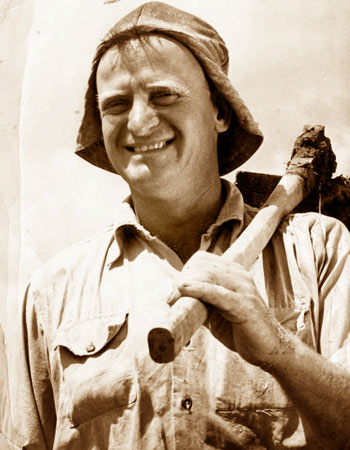
 Such as the one appearing on the
  The seven-branched candelabra was but a fraction of the exquisite mosaic floor exposed by Avshalom who used his hands literally to remove the soil and dirt covering the find. Construction work was stopped, and the Antiquities Authority arrived at the kibbutz. Excavations uncoverd an ancient synagogue.
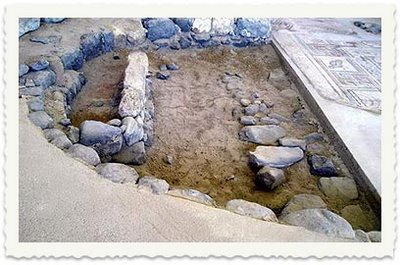 Underneath a the remains of a Bedouin cemetery, built on the ruins of an old Arab village, a Jewish town from the third century was found. The synagogue, constructed during the latter part of the century, served the Jewish community there for over 300 years, and was destroyed, along with the rest of the the town, in a large fire which broke out during the Arab occupation of the land. According to signs found in the area, the Jewish town was called Bala, and the Bedouins too kept that name.


 Also found at the dig: part of the tiled roof
 and this elaborately crafted object: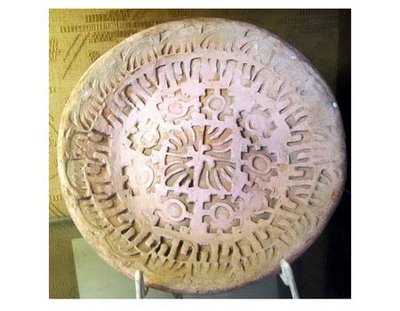
 ("rocket science" has become THE "cottage industry" of Gaza)


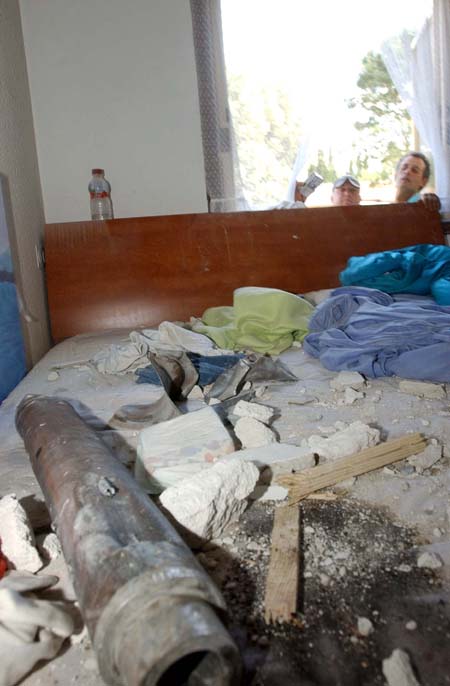


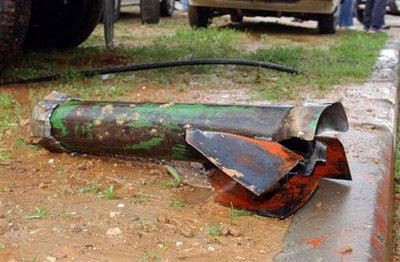
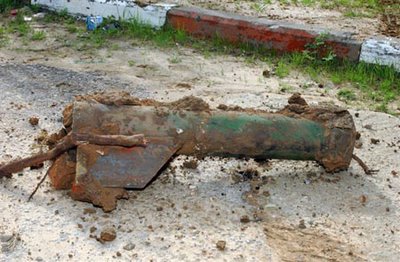


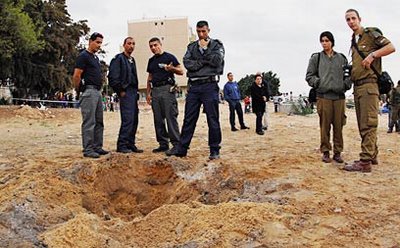


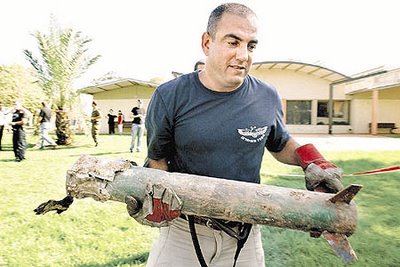

 (rockets found in a private residence in Nablus, West Bank)


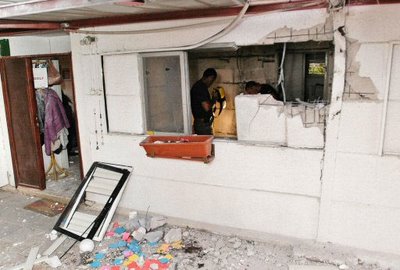
 (These are rocket-launching sites targeted by the IDF: Beit-Hanoun, Beit-Lahiya, Sheich-Ziyad, Al-Atatrah, Shuhada Cemetery, Giv'at Oranim, Officers Quarters - this last location was built to provide lodgings for Palestinian security officers).
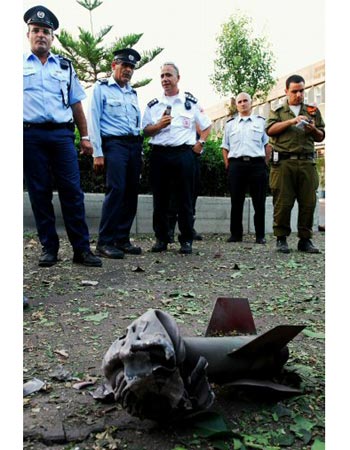


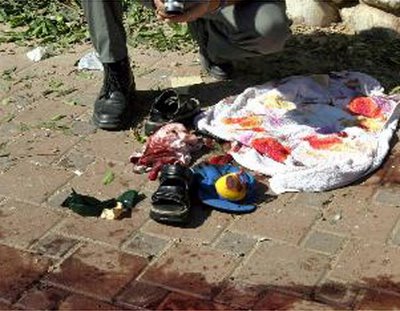
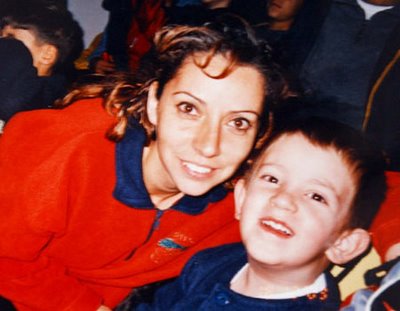
 This beautiful 17-year-old girl, Ella